Taj Khatoon. The Crown Lady.
My mother. Taj Khatoon. 1956 to 2023. What I learned the day I carried her to her grave, and what I want to beg you while you still have yours.
Photo by Markus Winkler on Unsplash.
…this is a very personal and emotional piece, one which makes me sad, and happy in some ways. If you've lost your parents (especially your mother), it might touch you, make you sad, so plan accordingly, if you can.
. . .
Taj Khatoon. Crown Lady. My beloved mother. (1956 to 2023.)
There is no one like a mother. Other than God. I didn't know what she meant to me. Not really. Not until I lost her in April 2023.
Let me tell you what she was like. And let me beg you to love yours (more) while you've her.
She was kind. Gentle. Quiet-ish. The mother of three boys. The wife of a similar quiet-ish husband. She used to say, with that small smile of hers, that she felt like she was running a boys' hostel. She was the most forgiving person I have ever met. I have not met another since.
I left her in my hometown in 2007. From then until 2023 we did not live in the same country, but we spoke almost every day (and met every year, some years twice). The days I couldn't call, she'd wait. And keep waiting. The next day, when I finally called, she would not complain. She would only ask if everything was okay. On the days she missed me more, she'd say it plainly. "I was waiting for your call." I never understood that line. Not really. Not until I became a father of two myself… Not until my Crown Lady was gone…
She would cry when I was sick. She would cry when my wife and kids were hurt. She'd pray for me as if I were still her newborn baby. She'd wake up before dawn and make duas/prayers for me in Tahajjud (early morning prayer). Sometimes she would tell me. Mostly, she would not.
The silly me thought I loved my dad more. (I lost him in 2008.) But it took me a long time to recover from her death. Or maybe I have not.
The losses she carried were not small. My father in 2008. Her only brother in 2016. Her sister in 2017. Two close friends (my parents-in-law) in 2020 and 2021.
The fatal sickness.
She would get sick. And then she would bounce back. She always bounced back. Until she didn't. Days before she died, in Ramadan (the fasting month for muslims), on a video call, she told me to stay put in Australia. I was 13,000 aeronautical miles away. "Don't worry about me," she said. I thought it was just another time she was sick. Another bounce-back coming. Maybe because it was Eid (the celebration after the fasting month hence she was asking me to stay put with my own family)…
She did not ask anyone around her to call me again and again. She did not ask me to come. But everyone told me later that she kept looking at the door. As if I'd be there any minute.
She was in and out of the hospital. Then someone in the family told me plainly that she was not well and that I should come. Leaving my young family in Australia for a long, unknown period was a choice. I made it, of course. Before I could buy my flight tickets, she went into a coma. Unresponsive.
Living far from family, you learn this fear early. You may not make it to the funeral. And my family are practising Muslims. In Islam, we bury our dead quickly. With or without me, my brothers would have to do what needed to be done.
The whole journey home, I prayed for her health. And deep down, I prayed something else too. If something is to happen, oh God, please let me be there. (A side note about my father. When he died, I was there in the hospital. Something I'll write about someday.) Melbourne to Bahawalpur. The Bahawal Victoria Hospital. BVH. It took me 36 hours. Each hour, I imagined the worst.
The moment I reached the ICU and held her hand, the beeping machine attached to her spiked. Her blood pressure went up. Right there on the screen. A tear fell from one of her eyes while I stood next to her, praying. She knew I'd reached…
She was on assisted breathing. Not yet on a ventilator. Unconscious. Everyone around her knew she knew I was there. I knew it too. For four days I sat with her. Two of my brothers were already there. Her family was complete. For me, at least, it was a comfort.
The ventilator and her passing…
After four days, the doctors decided to put her on the ventilator. We were not sure. Nobody we knew back home in Pakistan had ever come back from a ventilator. But there was no other choice.
As they prepared her, I saw her one last time. I prayed a hard prayer that day. Either make her well. Or take her back peacefully. End the misery. A tough thing to ask for…
We went out to the waiting area. Five minutes in, I saw a nurse running out of the ICU and going to the medicine store. She was fetching breathing equipment. Tubes. Things that should already have been in the room.
…my heart knew…!
We wanted to go in. Another nurse asked us to wait. Pray. Hope. The doctors are doing what they can. Five more minutes of agony. And then they called the three of us, her three sons, inside. The doctors were doing CPR. A senior doctor came over and told us. While they were doing the "endotracheal intubation", her body had stopped responding. Cardiac arrest.
I cannot tell you what those moments felt like. The world around me stopped. Every second became a million years. Tears down. Heart aching. Mind hurting. I kept reciting Quran for her.
Surah Al-Fajr 27-30, Quran.com "O tranquil soul, return to your Lord, well pleased and well pleasing. And enter among My righteous servants. And enter My Paradise." quran.com/89/27-30
The one I spoke with every day. The one who prayed for me while I slept. The one who told everyone how proud she was of me. Gone.
Every soul shall taste death, the Quran tells us.
No matter how much I had prepared myself in the last two weeks, that actual moment was bitter and harsh. (But God says we are not put through trials we cannot bear.)
It took us another hour or two to do the paperwork. Then we got her into the ambulance. Her body. (That is the harsh thing. The moment a person is no longer alive, we start calling them a body.)
One day, it will be me, I kept thinking. One day, it will be me.
. . .
Washing (Ghusl) and Janaza Prayer.
In Islamic tradition, before the burial, we cleanse the body. A warm gentle bath. Ghusl. To purify. To prepare. To wrap her in two or three white cloths for the next journey. I learnt something else that week. The moment a person passes, after you accept they are gone, you have to start arranging. You grieve while you organise. There is no pause for either.
We needed two women to perform the Ghusl. Only women may bathe a woman. The mosque and the neighbours arranged it within minutes. We needed a grave.
My mother always wished to be buried beside my father. We were extremely lucky. Right below his grave, there was a single space. Her last wish came true.
After Ghusl came the Janazah. The funeral prayer. In many countries, families ask the local imam to lead it. My brothers gave me the honour. They permitted me to lead the prayer for our mother. It is one of the highest honours a son can have.
I had asked God to let me be there if anything happened. He had answered. Thirty-six hours of travel. Thirteen thousand miles. And here I was, leading the funeral prayer for my own mother.
With my heart hurting, my eyes wet, and my lips reading the verses Islam teaches us to read at the end, I led the Janazah.
Then came the burial. The hardest part.
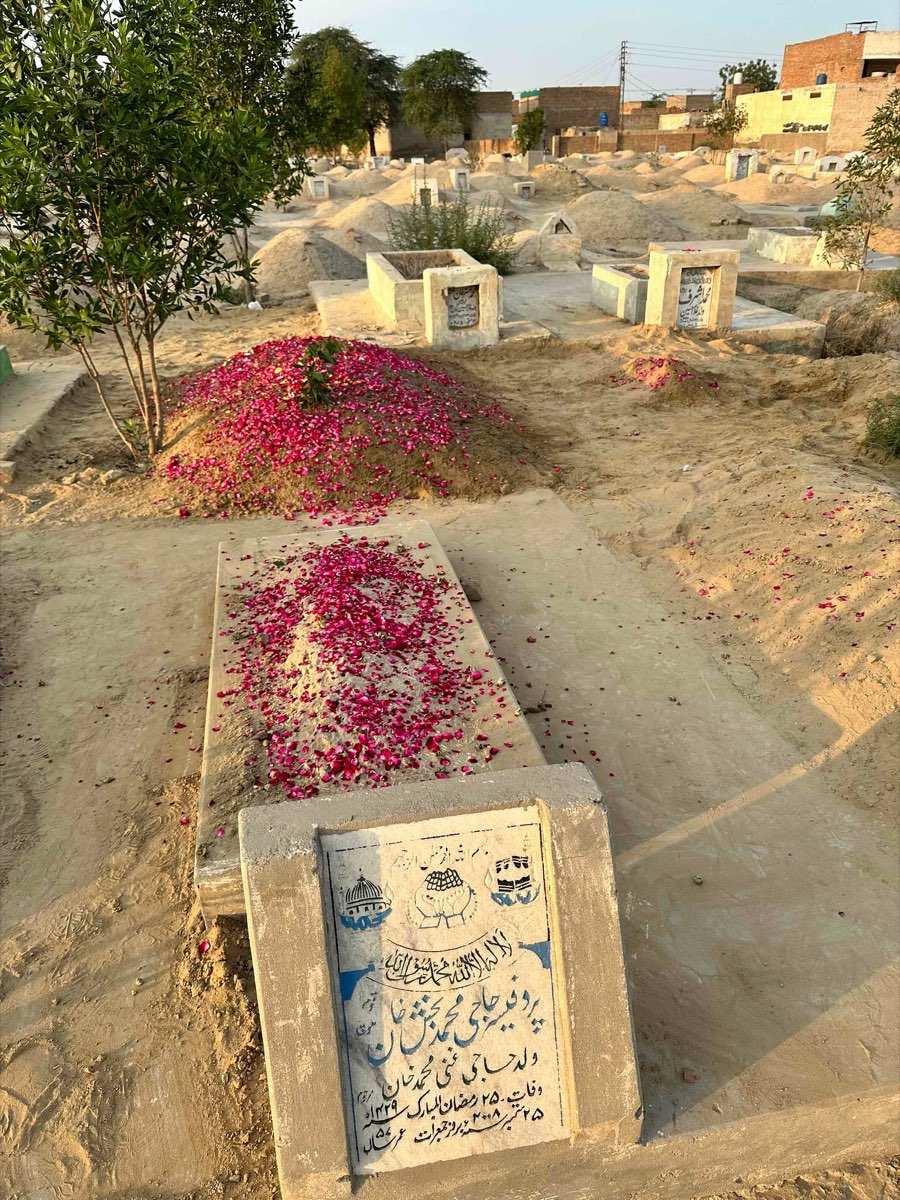
Graves of my father and mother, may they rest in eternal peace. Aameen.
Right after the janazah, I rushed to her grave. I climbed down. Six feet under the ground. A scary place. A reminder.
I prayed for her there, in her grave. I read the Quran. All the prayers and duas I could remember. To request that Mother Earth and her eternal worldly resting place be kind to her. So may God make her next journeys easy. (A human soul goes through a few journeys; I wrote about it in detail here.)
…and then it was time to put her to rest. I went down into the grave with one of my cousins. Her most beloved nephew. My brothers lifted her body from the stretcher and lowered her into our hands.
We covered her, lovingly, saying our goodbyes. We turned her face towards the Ka'aba, towards Mecca. We placed the safety ceiling above her. And then we covered the grave with dirt…
Messenger of Allah, peace be upon him said: "When a man dies all his good deeds come to an end except three: Ongoing charity (Sadaqah Jariyah), beneficial knowledge and a righteous son who prays for him."
Sunan an-Nasa'i 3651, Sunnah.com The Book of Wills, Sayings and Teachings of the Prophet Muhammad (saws) in English and Arabic. sunnah.com/nasai:3651
I hope to be that righteous son who prays for her and my father.
After more prayers, I went home. Visitors were waiting to offer their condolences. And, just like that, my family home was without my mother, forever. I stayed there for a few more days in pain and then flew back to Australia.
. . .
Every day, she is in my prayers. May she rest in eternal peace. Aameen. May we be raised together as believers on the day of resurrection. Aameen. May we be shown our way to Jannah, the gardens of Paradise, with love. Aameen.
There is no one like a mother. Other than God. Love yours, limitless, while you've her.
…with love and prayers.
Salam.
P.S. Amma (mother), I miss you. Every single day. Until we meet again.